3 March 2026
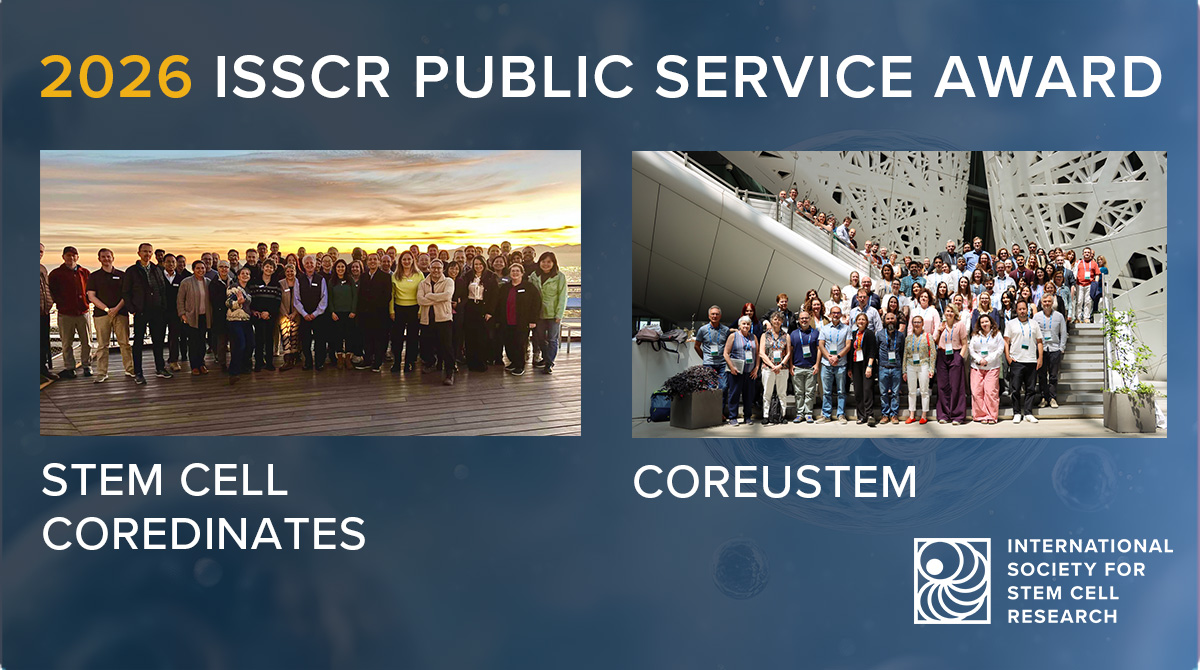
The ISSCR Honors Stem Cell COREdinates and CorEUstem with the 2026 ISSCR Public Service Award Global
Networks Recognized for Transforming Collaboration, Advancing Standards, and Expanding Equitable Access in Stem Cell Science
The International Society for Stem Cell Research (ISSCR) is pleased to announce Stem Cell COREdinates and CorEUstem as the recipients of the 2026 ISSCR Public Service Award. Together, these two global networks represent the world’s leading stem cell core facility consortia, uniting 79 core facilities across continents to advance collaboration, rigor, inclusivity, and innovation in pluripotent stem cell research.
The ISSCR Public Service Award recognizes outstanding contributions that strengthen the scientific community and advance the responsible translation of stem cell research for public benefit. Through their unprecedented coordination and commitment to shared standards, Stem Cell COREdinates and CorEUstem have reshaped the global infrastructure supporting stem cell science. The honorees will be recognized at the ISSCR 2026 Annual Meeting taking place 8-11 July 2026 in Montréal, Canada.
“Stem Cell COREdinates and CorEUstem exemplify what public service means in modern science,” said ISSCR President Hideyuki Okano. “By transforming isolated core facilities into a coordinated global network, they have elevated standards, strengthened reproducibility, and ensured that excellence in pluripotent stem cell research is accessible far beyond a handful of well-resourced institutions. Their work has built the technical and ethical foundation upon which future discoveries and therapies will stand.”
From Fragmentation to Global Integration
Before Stem Cell COREdinates and CorEUstem, pluripotent stem cell core facilities operated largely in isolation, with inconsistent reprogramming, differentiation, and quality control practices limiting reproducibility and equitable access. Today, 79 interconnected facilities function as a coordinated global ecosystem, harmonizing protocols, contributing to StemBook, ISSCR Standards, and CorEUstem Protocols.io, and benchmarking methods across institutions. By pooling expertise and aligning workflows, the networks have strengthened scientific rigor and accelerated translational progress worldwide.
Impact at Scale
The collective impact is measurable and transformative:
· 3,936 patient-specific and control hiPSC lines registered in hPSCreg.eu
· 4,058 gene-edited hPSC lines generated, including mutation corrections and custom reporter lines
· Broad dissemination of validated differentiation protocols supporting disease modeling, drug screening, and GMP-compliant applications
This shared infrastructure has helped enable advances such as bemdaneprocel, now in clinical trial for Parkinson’s disease, demonstrating how standardized core facility platforms underpin therapeutic innovation. Beyond numbers, these efforts are unlocking previously inaccessible research questions and accelerating global translation.
Collaboration as Infrastructure
Through active listservs, benchmarking initiatives, and international working groups, expertise flows rapidly across borders. Joint validation studies, including multinational protocol benchmarking efforts, have established internationally credible standards that no single facility could achieve alone.
Training has similarly scaled through collaboration, with more than 350 hands-on sessions annually reaching over 740 scientists worldwide – democratizing access to advanced methodologies and reducing disparities between institutions.
Inclusivity, Mentorship, and Responsible Science
Designed to lower barriers for emerging and under-resourced facilities, the networks openly share protocols and guidance while supporting the global dissemination of ISSCR Standards in multiple languages. Their mentorship model – pairing established cores with newer facilities and early-career scientists – ensures that technical expertise and leadership development advance together.
As gatekeepers of rigor and ethics, member facilities maintain strict quality control, regulatory compliance, and donor protection standards, working closely with registries such as hPSCreg to safeguard traceability and transparency.
Stem Cell COREdinates and CorEUstem demonstrate that the most profound advances in science occur not in isolation, but through shared purpose, shared standards, and shared opportunity. In honoring these networks with the 2026 ISSCR Public Service Award, the ISSCR celebrates a model of scientific infrastructure that advances discovery while strengthening equity, responsibility, and public trust.
Learn more about all of the 2026 ISSCR Award honorees.